
“Shovel haldai jane, bato banudai jane.” - We kept using the shovel and making a path as we went.
That is how our driver colleague Subhash Tamang described his journey into the flood-affected areas of Nuwakot and Rasuwa. Among the first colleagues from the Kathmandu office to reach the affected areas, Subhash said the journey from Galchhi towards Belkotgadhi, which would normally take around 20 minutes, took nearly three hours. The further they travelled, the more difficult the road became. In some places, sections of the road had simply disappeared. In Rasuwa, there were stretches where there was no road at all. They cleared stones and debris, used a shovel to make a path and slowly maneuvered the vehicle through whatever space was available.
“We had to keep looking at the road, the rocks, the vehicle and what was ahead,” he said. “You had to think before every turn.” They carried water, food, a shovel, an extra tyre and other essentials, knowing they could get stuck or have to spend the night on the road. His family, he said, supported him and told him to stay safe.
But the road was only the beginning of what Subash encountered.
People he met told him they had received warnings before the flood, but had not imagined its scale. They described it as a “manche khane khola” - a river that eats people. One person told him the waves came like the open mouth of a crocodile, swallowing everything in their path.
Subhash met a 16- or 17-year-old boy whose father and other close relatives had been swept away. His mother was abroad, and only his sister remained with him. The boy was anxious and struggled to speak. At a nearby monastery, families were waiting in queue to perform funeral rituals for those they had lost.
As Subhash recalled this, he paused. “Ke bhannu?” he said quietly. What could I say?
He spoke of seeing the devastation along the riverbanks and hearing from community members about people who had been swept away. “Na herna, na bolna sakne situation thiyo,” he said. It was a situation where you could neither look nor speak.
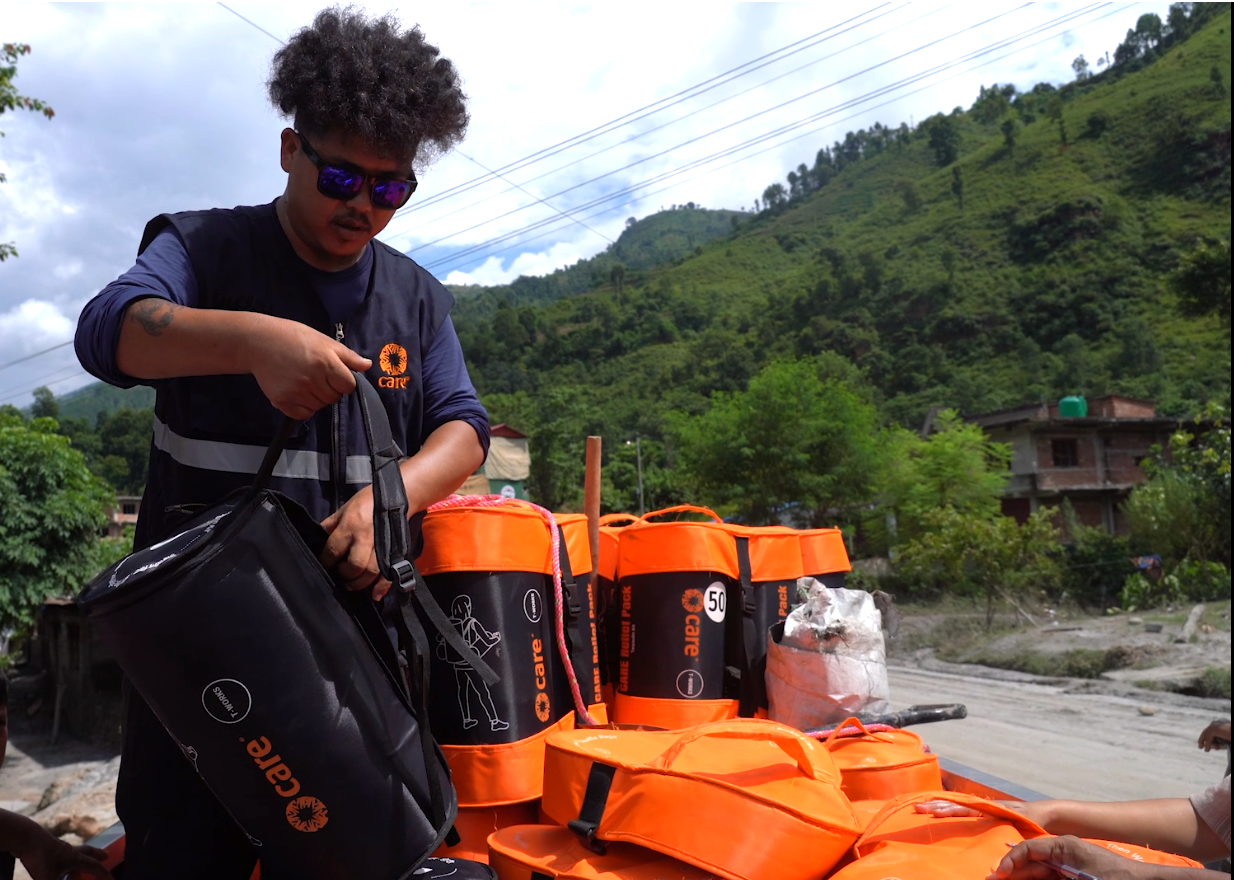
In Belkotgadhi, Subhash also supported the relief distribution, checking the CP4E packages to make sure they were in order and ready for use, and helping community members understand how to carry and use them safely.
He saw people with severe injuries and places he had known before the flood that were now almost unrecognizable. The landscape, marketplaces, and settlements had been swept away. He also saw children at holding centers, some waiting for their parents to return after collecting relief, and others who had lost their parents altogether. Their uncertainty, he said, stayed with him.
He also spoke about what people needed now, he spoke first about housing. Many families had lost their homes. But he quickly added: “Euta ghar diyera matra pani k garnu?” - Even if you give someone a house, what will they do without a livelihood?
People had lost not only their homes, he said, but also agricultural land and the means to support their families. For them to rebuild, he felt, they would need housing alongside livelihoods and access to basic services.
And when he spoke about CARE’s relief packages reaching families identified as most in need, there was a quiet sense of satisfaction in his voice.
For Subhash and our other driver colleagues, reaching these communities required more than knowing the route. It meant reading the terrain, anticipating risks, handling the vehicle carefully and making decisions under pressure. Sometimes, there was simply no road left.
For Subhash and our other driver colleagues, reaching these communities required more than knowing the route. It meant reading the terrain, anticipating risks, handling the vehicle carefully and making decisions under pressure. Sometimes, there was simply no road left.
They still found a way forward, making their own path.